日本の毎日のごはんです。お寿司や天ぷらばかりじゃない、普段のごはんを紹介しています。
My everyday food. It's not always Sushi,
not always Tempura...So, do you like Japanese food?
ad
2011年1月9日日曜日
ほうれん草 Spinach
ほうれん草のおひたしです。
鰹節をかけて、お醤油をつけるのが我が家の定番。
鉄分補給の味方ですね。
Boiled spinach.
We usually eat spinach with shavings of dried bonito and soy sauce.
ラベル:
Spinach,
ほうれん草,
冬(winter),
野菜(vegetable)
2011年1月8日土曜日
練りきり Nerikiri cake
鶴の練りきり。(Nerikiri cake shaped the crane)
練りきりは高級な和菓子。
生菓子で、柔らかい、上品な甘さですね。
しかも、季節の彩りをふんだんに取り入れて、
芸術的、とても美しいです。
Nerikiri is one of the Japanese sweets,
made of sweet bean paste.
It is elegant and beautiful designed to look like various seasonal characters.
こちらは亀(This means the tortoise)。
お正月なので、鶴と亀でめでたいです。
It is New Year,
the combination of the crane and tortoise is one of the lucky items,
shows the long life.
こちらは冬の花、椿。
This is camellia, one of the winter flowers.
練りきりは高級な和菓子。
生菓子で、柔らかい、上品な甘さですね。
しかも、季節の彩りをふんだんに取り入れて、
芸術的、とても美しいです。
Nerikiri is one of the Japanese sweets,
made of sweet bean paste.
It is elegant and beautiful designed to look like various seasonal characters.
こちらは亀(This means the tortoise)。
お正月なので、鶴と亀でめでたいです。
It is New Year,
the combination of the crane and tortoise is one of the lucky items,
shows the long life.
こちらは冬の花、椿。
This is camellia, one of the winter flowers.
ラベル:
お菓子(confectionery),
練りきり
2011年1月2日日曜日
おせち料理 Osechi-ryōri
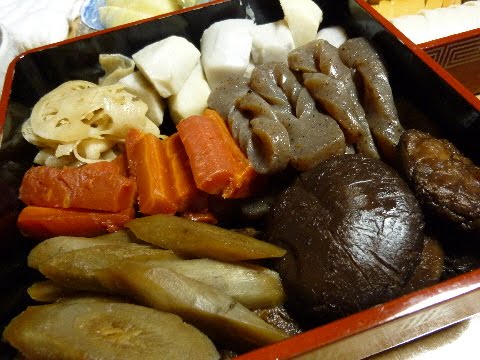
我が家のおせち料理です。
野菜のお煮しめとかまぼこ各種。
Osechi-ryōri are traditional Japanese New Year foods.
At my home, we simmer vegetables with soy sauce.
レンコン(lotus root)、さといも(taro)、
ニンジン(carrot)、こんにゃく(konnyaku~devil's tongue)、
ごぼう(burdock root)、しいたけ(shiitake mashroom)。
And some of Kamaboko.(processed fishfood product).
黒豆(Kuro-mame), black soybeans.
Mame also means "health," symbolizing a wish for health in the New Year.
豆のきんとんです。(Sweet bean paste)
そして、酢ダコ。(Pickled octpus)
2011年1月1日土曜日
お雑煮 Ozouni
お雑煮です。
我が家のお雑煮は野菜などで具だくさん。
お餅は四角、お醤油味のシンプルなお雑煮です。
Ozouni, the rice-cake soup is the special dish
for the New Year's Day.
Ozoni has different tastes from region to region.
ラベル:
New Year's Day,
ozouni,
お雑煮,
お正月
2010年12月21日火曜日
ゆず Yuzu
柚子です。
いいですね、この香り。
ゆず湯はもちろん、お雑煮の香りつけにも
いつも使ってます。
さわやか!
The yuzu is a citrus fruit from East Asia.
The flavor is closely resembling that of the grapefruit.
In Japan, we use it for bath on the day of
the winter solstice.
And it is often used for cooking
enjoying the flavor.
ラベル:
ゆず,
果物(fruits),
冬(winter)
2010年12月20日月曜日
みかん Satsuma (Citrus unshiu)
みかんです!
冬はやっぱり炬燵にミカン。
Mikan~The satsuma (Citrus unshiu), Japanese orange.
It is a seedless and easy-peeling citrus mutant of Japanese origin.
ラベル:
みかん,
果物(fruits),
冬(winter)
2010年11月14日日曜日
筆柿 Fudegaki persimon
筆柿です。
筆の先の形に似ていることから
この名前がついたとか。
味は濃くて甘いんです。
Fudegaki. It is one of the Kaki (persimon) species of Japan.
It has been cultivated around Aichi Pref. in Japan since some hundreds years ago.
So sweet, slightly tangy.
One of the autumnal tastes.
筆柿は愛知県幸田町の特産品。
別名「珍宝柿」。
江戸時代にはすでに栽培されていたのですね。
この名前がついたとか。
味は濃くて甘いんです。
Fudegaki. It is one of the Kaki (persimon) species of Japan.
It has been cultivated around Aichi Pref. in Japan since some hundreds years ago.
So sweet, slightly tangy.
One of the autumnal tastes.
ラベル:
果物(fruits),
柿,
秋
登録:
投稿 (Atom)